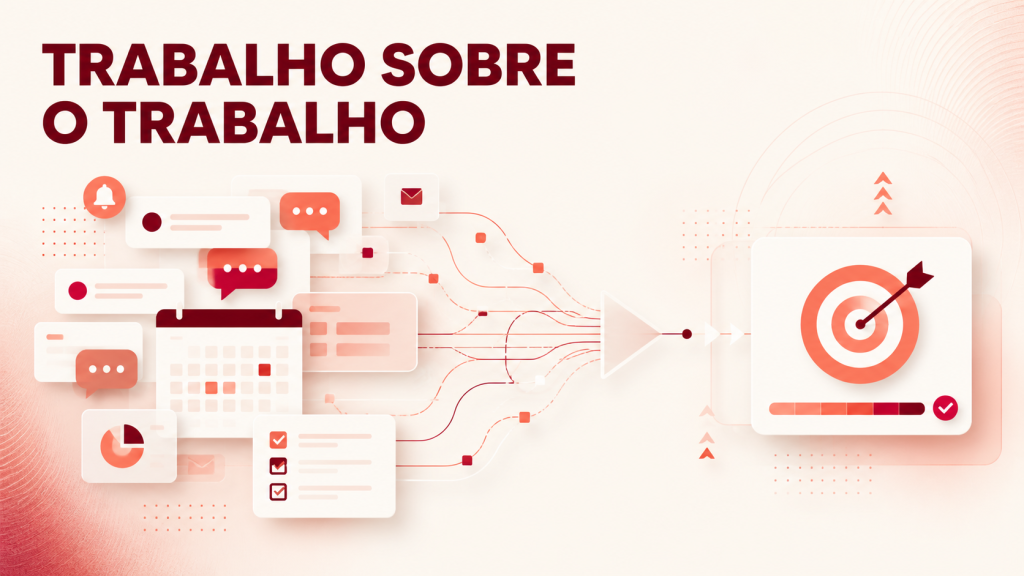
In a few words: work about work is the set of coordination activities — finding information, sharing status updates and deciding who does what — that consume time without directly producing the results a person was hired to deliver. According to the Asana Work Innovation Lab, knowledge workers spend more than half their time on this type of activity.
Consider an illustrative scenario, rather than a real client case: a head of operations compares two internal reports in the same week. The first shows a team with a full calendar every day. The second reveals that the quarter’s three strategic deliverables are still late. The difference between being busy and making progress is often hidden in something that never appears in timesheets: work about work.
This content is part of TaskWork Insights, focused on practical work management decisions.
An organizational design problem, rather than an individual failure
It is tempting to treat this as a matter of personal discipline: “If everyone organized their calendar better, this would not happen.” Experience with work management implementations shows another pattern. When people across different teams report the same symptoms — repeatedly searching for the same information, waiting for approvals without a clear owner or redoing work because criteria were undefined — the problem lies in the workflow design, rather than the person.
This is the article’s central argument: excessive work about work is primarily an issue of organizational design, allocation of responsibility and workflow structure, rather than an individual productivity failure.
This does not mean tools are irrelevant. It means they solve only part of the problem, and only after the underlying process has been intentionally designed. A structured implementation built on a poorly designed process merely digitizes the confusion; it does not resolve it.
Workplace productivity: what the data shows
The Asana Work Innovation Lab surveyed more than 13,000 knowledge workers in the United States, United Kingdom, Germany, Japan, Australia and France for its State of Work Innovation 2024 report.1 The central finding: busywork — exchanging status updates, finding information and communicating about tasks — consumes 53% of these professionals’ time, leaving 47% for the skilled and strategic work they were hired to do.1
The same report states that 94% of workers still rely on spreadsheets to manage their work, and 64% say their organization’s choice of collaboration tools makes work harder rather than easier.1 In addition, 63% report interruptions caused by too many tools.1 The report describes this fragmented search as part of a “velocity tax” associated with information bottlenecks.2 On an official page about the limitations of spreadsheets and data silos, Asana reports that workers lose nine hours a week searching for the information they need in these environments.3
These figures come from an international sample sponsored by Asana itself, which has a direct commercial interest in the topic. That does not invalidate the data, but it calls for two qualifications. First, no equivalent public measurement using the same methodology exists specifically for the Brazilian market; these figures indicate an international trend, rather than national statistics. Second, the organization funding the research also sells the solution presented as part of the answer, which matters when readers decide how much weight to give the findings.
| Indicator | Value | Source |
|---|---|---|
| Time spent on busywork | 53% | Asana Work Innovation Lab, State of Work Innovation 20241 |
| Time spent on skilled work | 47% | Asana Work Innovation Lab, State of Work Innovation 20241 |
| Reliance on spreadsheets | 94% | Asana Work Innovation Lab, State of Work Innovation 20241 |
| Collaboration tools make work harder | 64% | Asana Work Innovation Lab, State of Work Innovation 20241 |
| Interruptions from too many tools | 63% | Asana Work Innovation Lab, State of Work Innovation 20241 |
| Time searching for information in spreadsheets and silos | 9 hours per week | Asana, “Read this if you still manage your work in spreadsheets”3 |
The three gaps diagnostic
The framework below is an editorial model developed by TaskWork to organize patterns observed in the implementation and adoption of work management tools. It is not statistical research and should not be confused with an academic study or Work Innovation Lab methodology.
Information gaps
Symptom: the same question is asked repeatedly because the answer is not recorded in one accessible place. Impact: time is wasted rebuilding context, with excessive reliance on specific people who “know where everything is”. Diagnostic question: if the owner went on vacation today, could someone find the history without asking them? Initial action: map where the critical information for one specific routine lives today, rather than the whole company at once. Possible use of a platform like Asana: centralize related tasks, comments and files in one workspace, reducing fragmentation across email, chat and separate spreadsheets. Tool limitation: no platform resolves information gaps if people continue making decisions and recording agreements outside it, in informal conversations that leave no trace.
Decision gaps
Symptom: tasks sit “awaiting approval” without a visible deadline or a clear decision-maker. Impact: cascading delays accumulate throughout the workflow, even when each individual stage was completed quickly. Diagnostic question: before asking “when will it be ready?”, can you say with certainty who owns the final decision? Initial action: list the decision points in one process and assign one owner to each — a person, rather than a committee. Possible use: status fields and approval rules visible to everyone involved, removing ambiguity about where a task is stalled, a particularly common need in PMO and strategy. Tool limitation: assigning an “approver” field in the system does not replace formal decision-making authority within the organization. If the named approver has no actual mandate to decide, the field becomes decorative.
Accountability gaps
Symptom: inconsistent deliverables because there is no objective, shared definition of “done”. Impact: recurring rework and conflict over who should have spotted the problem before delivery. Diagnostic question: is there an objective acceptance criterion for this type of deliverable today, or does everyone apply their own standard? Initial action: review recent problematic deliverables and check whether each had a single identified owner and written acceptance criteria. Possible use: assign one owner per task, combined with required acceptance-criteria fields before marking anything complete. Tool limitation: assigning a task in the system does not, on its own, create accountability; that depends on management culture and real consequences associated with meeting or missing commitments.
How the three gaps connect
These gaps rarely appear in isolation. An information gap feeds a decision gap because the decision-maker lacks the data to act confidently. A decision gap then feeds an accountability gap because nobody wants to own the outcome of a decision that was not clearly theirs. This chain explains why isolated solutions — training alone, a new tool alone or another report alone — rarely solve the problem permanently. They address one symptom while the chain remains active elsewhere in the workflow.
Warning signs in team productivity
Some signs appear before the problem shows up in formal productivity metrics. Weekly status meetings with no new decisions often indicate decision gaps. Repeated questions about “where the latest file is” indicate information gaps. Arguments about “whose responsibility it was” after a mistake indicate established accountability gaps. No single sign is cause for alarm on its own, but systematic repetition across several teams is.
Practical checklist: the three gaps diagnostic
- Is there one place where the critical information for each routine is recorded?
- Does each decision point have one identifiable owner?
- Are acceptance criteria documented for the most common deliverables?
- Did the last three problematic deliverables have clear owners?
- Can the team name who approves each request type without looking it up?
What often goes wrong when trying to improve productivity
A common implementation pattern is trying to solve all three gaps by buying and configuring a tool before mapping the actual process. The result is often a digital version of the previous chaos: the same unowned decisions inside a better-looking system. Another pattern is excessive premature automation. Automating a workflow before responsibilities are agreed merely accelerates a poor process, delivering the same problem faster.
A 30-day plan as an initial diagnostic cycle
The plan below is an initial cycle of diagnosis and adjustment, rather than a universal promise of results. The time required varies with team size, process complexity and resistance to change — factors that can only be assessed case by case.
Week 1 — Map: document the actual workflow of one process, rather than the whole company, identifying where information lives, who decides what and who owns each deliverable.
Week 2 — Define: for each gap identified, assign one owner, explicit acceptance criteria and one place where relevant information must be recorded.
Week 3 — Pilot: apply the week 2 definitions with a controlled group, supported by change managementpractices, rather than across the whole organization at once. A failed small-scale pilot costs far less than a failed full rollout.
Week 4 — Measure: compare warning signs before and after the pilot using concrete indicators, rather than impressions alone, such as time to approval, repeated questions or rework rates for specific deliverables.
Why measurement is the most neglected part of the cycle
Of the four weeks in the initial plan, measurement is often skipped. After a three-week pilot, teams commonly declare “it worked” or “it did not work” based on general impressions, without having recorded baseline figures before the change. Without a baseline, it is impossible to distinguish sustained improvement from the temporary effect of extra attention during the pilot. It also becomes difficult to justify expansion to those funding the initiative.
Useful measurement does not need to be sophisticated. Before the pilot, recording how often a question was repeated in a communication channel each week, or the average time for a particular approval, is enough for an honest comparison afterward. The aim is not to build a permanent dashboard in the first round, but to establish a comparison point simple enough to maintain without extra effort.
This cycle can and should repeat. The first round rarely solves everything; it reveals where the gaps really are and creates an evidence base for next steps. Those might include expanding the pilot, adjusting the process before trying again or recognizing that the root cause lies elsewhere in the organization.
The role of consulting in this process
A work management consultancy does not replace leadership’s decision about how to allocate responsibility; that is a management decision, rather than a system configuration choice. A consultancy like TaskWork adds value in three specific ways: conducting diagnosis with an external perspective less affected by internal politics; translating process requirements into technical configuration on a platform like Asana; and supporting the pilot with an explicit methodology to prevent initial enthusiasm from fading during the first weeks of real usage. This assumes diagnosis and process design happen before, or at least alongside, tool configuration, rather than afterward.
Executive conclusion
Reducing work about work is an organizational design exercise supported by tools, rather than a software purchasing project. Companies that treat Asana or any other work management platform as an end in itself tend to digitize the same bottlenecks they already had. Those that treat the tool as the result of a well-designed process tend to achieve what they wanted from the start: less time coordinating work and more time doing the work that matters.
FAQ
What exactly is “work about work”?
It is the set of coordination activities — finding information, communicating status and deciding responsibilities — that consume team time without directly producing the expected work outcome.
Is work about work the same as rework?
Not exactly. Rework means redoing something completed incorrectly or incompletely. Work about work is broader: it includes coordination, information searches and status alignment, even when nothing needs to be redone.
Does buying a work management tool solve the problem?
Not on its own. The tool can reduce coordination friction, but it only works well on a process with clear responsibilities and criteria defined before configuration.
How long does it take to reduce work about work in a team?
It varies with team size, process complexity and resistance to change. The 30-day plan in this article is an initial diagnostic cycle, rather than a guaranteed timeline.
Do the 53% and 47% figures apply to Brazil?
The data comes from an international Asana Work Innovation Lab sample, with no publicly available Brazil-specific breakdown. It indicates a trend, rather than national statistics.
What is the difference between a poorly designed process and a poorly configured tool?
A poorly designed process lacks clear responsibilities and criteria, regardless of the tool. A poorly configured tool may reflect a sound process, but in a technically inadequate way. The two problems require different diagnoses.
Does TaskWork guarantee less rework after implementation?
No. No consultancy can guarantee that outcome because it depends on organizational factors, adoption, management culture and leadership support that go beyond technical configuration.
Want to identify where your team is losing time to work about work? Talk to TaskWork for an initial process assessment.
Asana Work Innovation Lab. State of Work Innovation 2024, Global Report. 2024. Available at: https://assets.asana.biz/m/7247625de89a76e6/original/State-of-Work-Innovation-2024_Global.pdf. Accessed August 1, 2026.↩
Asana Work Innovation Lab. State of Work Innovation 2024, Global Report, “Information hide-and-go-seek” section (“Velocity Tax”). 2024. Available at: https://assets.asana.biz/m/7247625de89a76e6/original/State-of-Work-Innovation-2024_Global.pdf. Accessed August 1, 2026.↩
Asana. Read this if you still manage your work in spreadsheets. Published November 5, 2025. Available at: https://asana.com/pt/resources/asana-versus-spreadsheets. Accessed August 1, 2026.↩